 Afternoon Edition
Thirty Spoonfuls to the Bottle, and Two Different Return Policies for the Same Sixty DaysOne tablespoon of orange-flavored fish oil carries 1,500 milligrams of EPA and DHA, the amount the large trials used. I weighed that spoon against what the people in those trials actually swallowed, and read what happens to the sixty days once you open the cap.
Omega-3 Power Squeeze is an emulsified fish oil from BrainMD, a supplement company in Irvine, California, that you take by the spoon: a tablespoon weighs 15.9 grams and holds 910 milligrams of EPA and 590 of DHA. I put that spoon on a kitchen scale, set it beside the dose each trial gave its participants, and read the return terms line by line before I wrote a word about whether it is worth your money.

This is a paid advertisement. Sponsored by BrainMD.

Roland Avery is the pen name of this desk.
Everything on this page about the bottle comes from the seller's own label, product page and posted policies, read on September 20, 2026.
The customers quoted further down are real, and their reviews are public on the seller's site.
The small photographs beside them are illustrations, not the reviewers.
My father took fish oil every day for eleven years and never once knew how much of it he was taking.
He knew he took two capsules, because two was what the lid said.
That is the whole trouble with this category, and it is why I write about labels for a living.
A number on a bottle only means something once you put it beside the number a study used.
So this page is about a spoon, and what that spoon weighs.
The product is called Omega-3 Power Squeeze.
It is a thick, orange-flavored fish oil in a tall opaque bottle with a cap you squeeze, made for BrainMD, a supplement company in Irvine, California.
You do not swallow anything.
You squeeze a tablespoon of it, and you eat the tablespoon.
Thirty tablespoons to a bottle, one a day, and the bottle is done in a month.
That is the shape of the thing, and everything below is read inside it.
Here is what I set out to answer: what a tablespoon weighs, whether that weight is the weight the trials used, what else is in the spoon besides fish oil, and what the sixty-day return window is actually worth once the cap is off.
One more thing before the first item, because most of you arrived here from one of our own advertisements.
Those advertisements talk about a boxed cereal, three foods, three drinks, and three words a man is supposed to be able to say.
None of that is in this bottle, and I am not going to pretend it is.
It is on this page in its own place, the eighth item, with the studies beside it, and every headline we run is written out with an honest verdict in the guide linked at the foot.
Item one · What arrivesA Tall Opaque Bottle, a Squeeze Cap, and Thirty Spoonfuls Counted Out
This is what comes in the box.
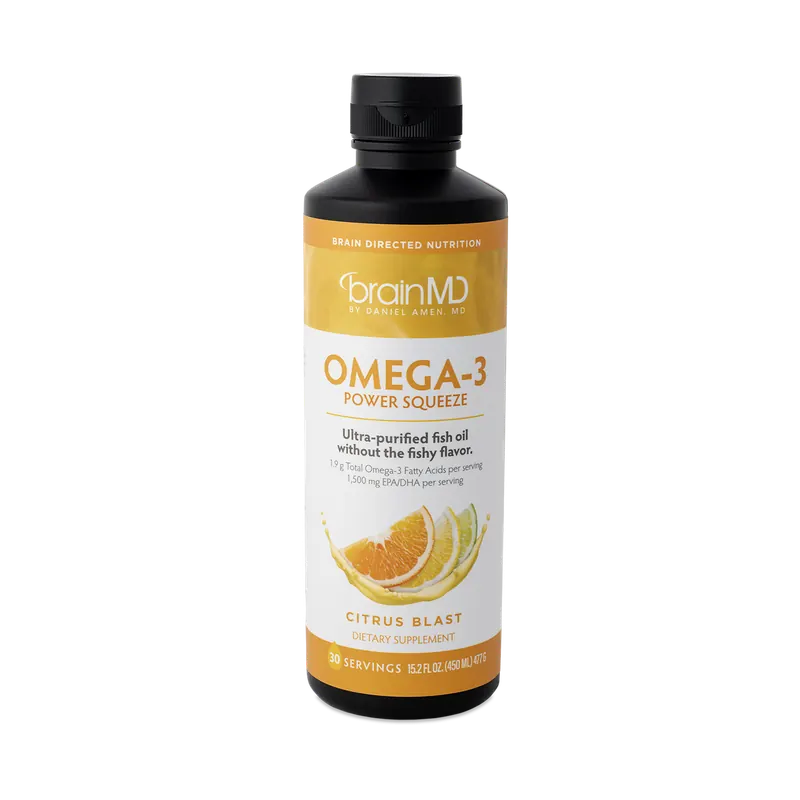
A 450-millilitre bottle, which the label prints as 15.2 fluid ounces, in dark plastic that keeps the light off the oil.
The serving is one tablespoon, and the panel says thirty servings to the bottle.
The flavor on the front of the label is Citrus Blast.
The seller's own description calls it creamy and orange-vanilla, which is closer to what it tastes of.
The texture is the first surprise.
This is not a thin yellow oil that rolls off a spoon; it is emulsified with water and two gums, so it sits on the spoon like a thick cream.
That matters more than it sounds.
An emulsion is why a man who gave up on this category years ago can get it down at all, and taste is the only reason anyone takes anything every day for a month.

Item two · The weight of the spoonFifteen Point Nine Grams on the Scale, of Which 1,500 Milligrams Do the Work
Now the arithmetic, which is the reason this page exists.
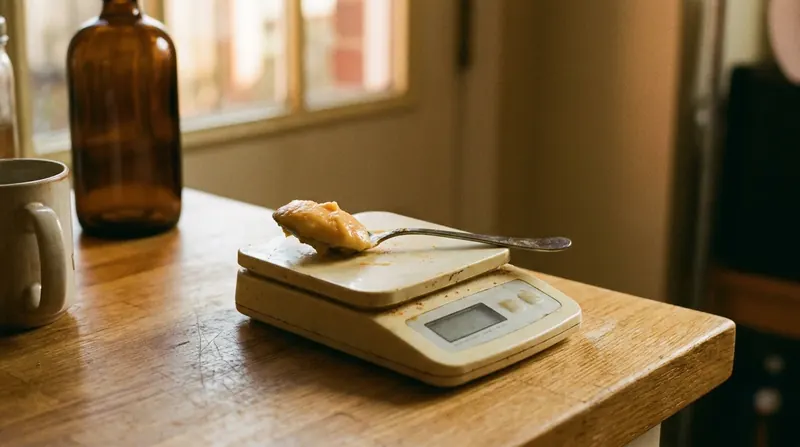
The panel gives the serving as one tablespoon, 15.9 grams.
That is the whole spoonful: oil, water, sweetener, gums and flavoring together.
Of those 15.9 grams, the omega-3 fats come to 1.9 grams.
The panel breaks them down: 910 milligrams of EPA, 590 milligrams of DHA, and 370 milligrams of other omega-3s.
Nine hundred and ten plus five hundred and ninety is exactly 1,500.
That is the figure the front of the label promises, and for once the front and the back of a bottle agree to the milligram.
I want to give that its due, because it is rarer than it should be.
On this desk, most panels quietly hold a third of what the front implies, and this one does not.
The rest of the spoon is ordinary.
Seventy calories, five grams of fat, five grams of carbohydrate, no sugars, and four grams of a sweetener I will come back to in the fifth item.
The oil itself comes from anchovy, sardine and mackerel.
If you have a fish allergy, that sentence is where this page ends for you.
One tablespoon, 15.9 grams on the scale, 1,500 milligrams of EPA plus DHA, and a front label that matches its own panel.
Item three · What the trials handed outThree Large Trials in Older Adults, All of Them at This Dose or Above, All of Them Empty
Here is the part most pages about fish oil leave out.
The 1,500 milligrams in this spoon is not a small dose that nobody has tested.
It is a large dose that has been tested repeatedly in people my age, and the results are not what the advertising implies.
Start with the largest reading of them all.
A 2012 Cochrane review pooled three trials with 3,536 participants aged 60 and over and found no difference between omega-3 supplements and placebo on a standard mental-status score after 24 or 40 months. [1]
The same review found nothing on word learning, on digit span, or on verbal fluency. [1]
Those are the three things a man over 60 actually notices, and the review found nothing on any of them.

Then the Australian trial, which went the other way on dose.
Three hundred and ninety healthy adults aged 65 to 90 took 2.3 grams a day of a DHA-rich fish oil for eighteen months, and their thinking did not improve. [2]
Look at what those people swallowed.
Their daily dose held 1,720 milligrams of DHA and 600 of EPA: nearly three times the DHA in this spoon, and more of everything. [2]
The trial reported something else worth your attention.
The fish-oil group was slightly slower on a psychomotor task and reported more small everyday slips than the placebo group. [2]
Then the Swiss trial, which is the largest of the three.
Two thousand one hundred and fifty-seven adults aged 70 and over took one gram of omega-3s a day, or vitamin D, or a strength-training program, alone and in combination, for three years. [3]
On the cognitive screening score, none of it moved the needle. [3]
Not the omega-3s, not the vitamin, not the exercise, and not the three of them together.
Three trials, thousands of people my age, doses at and above this spoon, and no result.
I am going to say plainly what that means for the bottle on my counter.
If you are a healthy man over 65 and you want a daily tablespoon to sharpen you, the largest trials of exactly this dose say it will not.
Cochrane: nothing in 3,536 adults over 60. [1] Australia: nothing in 390 adults 65 to 90 on more than this spoon. [2] Switzerland: nothing in 2,157 adults over 70. [3]
Item four · The one with a signalA Pooled Analysis About People Who Already Notice Their Memory, and a Two-Year Trial With Three Nutrients
It would be dishonest to stop there, because two readings do point somewhere.
The first is a 2015 pooled analysis of trials in healthy adults.
It found that DHA, alone or with EPA, improved episodic memory in adults with mild memory complaints, and that doses above one gram a day of DHA plus EPA improved episodic memory whatever a person's starting score. [4]
Read that sentence twice, because the qualifier is the whole story.
The signal was in people who already noticed their memory slipping, and it was in episodic memory, which is the memory for events, not in working or semantic memory. [4]
On dose, this spoon clears the bar.
One and a half grams of EPA plus DHA is comfortably above the one gram a day that analysis singles out. [4]

The second reading is a two-year trial in Ireland.
Sixty adults aged 65 and over, all of them thinking normally, took one gram of fish oil a day together with 22 milligrams of carotenoids and 15 milligrams of vitamin E, and made fewer errors on working-memory tasks than the placebo group. [5]
The effect sizes were small, between 0.09 and 0.11, and they grew as the tasks got harder. [5]
The fish oil in that trial carried 430 milligrams of DHA and 90 of EPA, which is well under this spoon, and it never travelled alone. [5]
So the honest summary of the one positive trial is that it tested three nutrients together, at a lower fish-oil dose, in sixty people, and measured a small effect.
You cannot buy that trial in a bottle, and this bottle is not it.
A 2018 review that read 51 trials came to the same shrug I have arrived at.
It concluded that it is still unclear whether long-chain omega-3s improve thinking or slow its changes, in younger or in older adults. [6]
The pooled analysis with a signal was about people who already notice their memory, above a gram a day. [4] The two-year trial with a small effect combined fish oil with two other nutrients. [5] A review of 51 trials calls the question open. [6]
Item five · The sweetenerFour Grams of Xylitol in Every Spoon, and Why This Bottle Lives on a High Shelf
Now the line on the panel nobody puts in an advertisement.
The label says no sugar, and that is true: zero grams of sugars.
The sweetness comes from four grams of xylitol per tablespoon, a sugar alcohol, and that is a different sentence from the one the front of the bottle tells.
For a person, four grams is a small amount, and the usual complaint about sugar alcohols at much higher doses is a loose stomach.
For a dog, it is another matter entirely.

The Food and Drug Administration has a consumer notice about exactly this.
It says xylitol is absorbed quickly in dogs and can trigger a strong release of insulin and a rapid, deep drop in a dog's glucose within ten to sixty minutes, while in people it does not stimulate insulin at all. [7]
So the bottle goes on a high shelf, and the spoon goes straight into the dishwasher.
That is the whole of the caution, and it is a caution about the kitchen rather than about you.
The rest of the ingredient line is unremarkable.
Water, glycerine, gum arabic, flavorings, citric acid, xanthan and guar gums, an antioxidant blend to keep the oil from turning, beta carotene for color, and sorbic acid.
Four grams of xylitol a spoon, which is nothing for a man and a genuine hazard for a dog. [7] High shelf, closed cap, spoon in the dishwasher.
Item six · The tasteThree Hundred and Twenty-Three Reviews, and What They Are Actually About
The seller's page carries 323 reviews with an average of 4.85 stars, and 316 of them carry the seller's purchase mark.
I read them and then I read them again with a pencil, because a star rating tells you almost nothing on its own.
Here is what they are about.
Almost every single one of them is about the taste, the texture and the absence of a fishy aftertaste, and almost none of them is about memory.
That is not a criticism of the reviewers.
It is the most useful thing on the whole page, because taste is the variable that decides whether a bottle gets finished or ends up behind the vinegar.
Three are worth quoting, and I have kept one that gave four stars rather than five.
The small photographs beside them are illustrations, not the people who wrote them.

This form of Omega 3 is palatable, fresh, tasty and has no fish scent. The dark bottle protects the liquid from sunlight. Easy to squeeze the right amount, easy to taste and swallow.

I've tried several omega supplements over the years, and this is the only one I've actually enjoyed taking. The squeeze tastes great with no fishy aftertaste and I've been able to use it consistently.

I like this product because other fish oils do not agree with my system. I can digest this one. There is no fishy taste.
Read those three again and notice what none of them claims.
Not one of them says it did anything for their memory, and I would not have printed it if it had.
The real product here is that you will actually take it.
Item seven · The sixty daysOne Window, Two Policies: Unopened Buys a Refund, Opened Buys Store Credit
This is the item I would read first if I were you, and it is the one the advertising never mentions.
The seller's posted policy gives you sixty days from purchase.
Inside that window, an unopened bottle gets you the price of the product back, less what you paid for shipping.
An opened bottle is a different transaction.
Inside the same sixty days, an opened bottle gets you store credit up to the original amount, not your money returned to the card.

And in either case, the cost of posting it back is yours.
An exchange is also on the table, and the same sixty days apply.
Now put that next to the product itself.
You cannot know whether you can stand the taste of an orange-flavored fish oil without opening the bottle, and the moment you open it you have moved from the refund column to the credit column.
I am not calling that unfair.
Sixty days is a longer window than most, and a policy that lets you send back an opened food product at all is more than the law requires.
I am calling it something you should know before you click, not after.
If you would only buy this on the understanding that you can get your money back after tasting it, then the honest answer is that you cannot.
What you can get, after tasting it, is credit with a company whose other products you may or may not want.
That is a smaller thing, and it is the real shape of the sixty days.
Sixty days either way: unopened buys the product price back, less shipping, and opened buys store credit up to what you paid. Return postage is yours in both cases.
Item eight · The bowl and the cupThe Cereal, the Three Drinks, the Three Foods and the Word Test From Our Own Advertisements
Our advertisements have been saying, in one version or another, that a boxed cereal, three foods and three drinks have something to do with memory, and that there are three words a man ought to be able to say.
You are owed the sober version in one place, so here it is.

Start with the bowl.
A frosted, honey-coated or chocolate cereal is mostly refined starch and added sugar, and one serving can carry more sugar than a cookie.
No cereal ages a brain faster than time does.
Nobody has measured any such thing, and that phrase was written to be clicked.
What the evidence says is duller and worth more.
In a Brazilian study of 10,775 adults followed for a median of eight years, the people who ate the most ultra-processed food slipped on thinking tests about a quarter faster than the people who ate the least. [8]
That is an association across a population over years, not a verdict on your breakfast.
It is also the best single answer to every cereal headline we have ever run.
The three drinks.
The evening drink in our advertisement is alcohol, and it is where the evidence is strongest: in 550 British civil servants followed for thirty years, the more a person drank the faster their word-fluency scores fell, and light drinkers had no edge over those who did not drink at all. [9]
The second is sugar in a glass: soda, sweetened bottled tea, the tall flavored coffee from the counter.
They sit on the same ultra-processed shelf as the sweet cereal, and that is the honest case against them. [8]
The third, in one version of our headline, was coffee.
That was our worst headline, and none of the studies on this page is about a plain black cup.
Keep your coffee. Put down the third glass of sweet tea.
The three foods.
Processed meat, deep-fried food, and the white-flour shelf: pastries, packaged cakes, white bread.
Our advertisement says just stop eating these three.
The evidence says something slower and less satisfying.
In a three-year trial of 604 older adults, one group ate the MIND pattern of vegetables, berries, nuts, whole grains, beans, fish and olive oil, and the other ate its usual food with slightly fewer calories.
Both groups' thinking scores rose, by about the same amount. [10]
Fish is the one item on that list that connects to the bottle on my counter, and it is also the cheapest way to get what is in the spoon.
Two portions of oily fish a week gets you into the same range, on a plate, at the price of sardines.
There is one more line in that literature worth your afternoon.
In the Framingham families, 1,391 adults whose everyday food carried more choline, which is eggs, milk, meat and beans, scored better on verbal and visual memory tests. [11]
That is an association across a town, not a result for any bottle.
It is also a shopping list you already have.
The three words, or the three phrases.
There is no such list.
What our advertisement borrowed from is the short, scored mental-status check a clinician gives in person: the date and the place, a few words to hold and hand back a minute later, a sum, naming, copying a drawing.
It is read against your age and your schooling by someone trained to read it, and a low score is a reason for a proper look, not a verdict.
Stumbling on a word when you are tired or being timed means nothing on its own.
If the worry behind the click is real, that is fifteen minutes with your own clinician and not a quiz on an advertising page.
And the advertisement about the things some men take every day.
That one sits closest to real research, and it is the one an advertisement has no business acting on.
Put everything you take in one bag, this bottle included, and take it to the pharmacist.
Name the omega-3 dose out loud while you are there: a gram and a half a day is worth mentioning if you take anything that thins the blood or have a procedure coming.
So if you clicked on the cereal, here is where it went: onto a counter beside a tall dark bottle, where the answer was always a plainer bowl, a fillet of fish, and the coffee you already had.
Item nine · What it is notSix Things a Tablespoon of This Will Not Do
- It will not come with a trial of itself. Nobody has tested this bottle; the trials tested fish oil at measured doses in other people.
- It will not do what the three large trials could not. At this dose and above, in healthy adults over 60 and 65 and 70, they found nothing. [1] [2] [3]
- It will not act on anything a clinician has named. It is a dietary supplement, and its own label carries the sentence that says so.
- It will not let you taste it first and still get your money back. Opening the bottle moves you from the refund column to the store-credit column.
- It will not replace two portions of fish a week. It is a convenient way to get the same fats, not a better one.
- It will not be a small ask of your month. Thirty spoonfuls is thirty mornings or thirty evenings in a row, and a bottle that stops getting used stops counting.
If that list annoys you, I would rather you were annoyed now than on the thirtieth day with an empty bottle and no idea what it did.
Item ten · If you buy itOne Bottle, One Time of Day, One Notebook, and Thirty Lines
If you are going to try it, try it as a test with a date on it.
- Buy one bottle. Thirty spoons is a month, and a month is a fair test of a taste.
- Tie the spoon to something you already do without thinking. The same meal, every day, is the only thing that has ever worked for me.
- Take the bottle to the pharmacist before the first spoon, with everything else you take, and name the gram and a half of omega-3s.
- Keep it on a high shelf with the cap closed, away from the dog, and wash the spoon straight away. [7]
- Write one line a day in a notebook. Not sharper or foggier: what you were doing at four in the afternoon, and how it went.
- Eat fish twice a week anyway, and count that as part of the same test.
- On the thirtieth day, read your thirty lines beside the thirty before them. That is the only trial of this bottle you will ever get.

Look at that list the way I do.
Six of the seven things on it cost nothing.
This is worth a look if:
- You have tried fish oil twice and stopped both times because of how it went down.
- You want a dose you can check against the trials rather than a blend with no numbers on it.
- You will eat fish as well, and take the spoon on the days you do not.
- You accept that opening the bottle means credit rather than a refund if you hate the taste.
Give it a miss if:
- You have a fish allergy. The oil is anchovy, sardine and mackerel.
- You take anything that thins the blood, or have an operation booked, and have not asked the pharmacist yet.
- You want the bottle to do what the large trials could not. It will not.
- You keep a dog who gets on the counter, and you know you will leave the cap off.
Item eleven · Where it comes fromIrvine, California, With a Street Address, a Weekday Telephone Number and an Email
The bottle is sold by BrainMD, and that is the only place this page links to.
The company publishes a street address in Irvine, California, a toll-free telephone number that answers on weekdays, and a customer-support email.
Everything ships from Southern California, and shipping is included above a spend of seventy-five dollars in the lower forty-eight states.
I will say one plain thing about the name on the label, because you will see it when the box arrives.
The brand carries the name and the medical credential of the person who founded it, and this page does not use either of them as an argument.
A credential on a label is not evidence about a bottle.
The three trials above are evidence, and they are the reason this page reads the way it does.

Buy one bottle.
Thirty spoons is a month, and the pharmacist comes first.
Read the panel, then read your month.
Every line of the panel, with its plain English name, its amount per tablespoon and the trial behind it, is written out in the ingredient and advertising guide linked at the foot of this page.
It also explains the xylitol line for anyone with a dog, and says which of our own headlines this bottle does and does not support.
Where to get it
One tablespoon of citrus-flavored fish oil from a squeeze bottle, with 1,500 mg of EPA and DHA, instead of a handful of capsules.
CHECK AVAILABILITYSold by BrainMD, Irvine, California · 15.2 fl oz, thirty tablespoons · 1,500 mg of EPA plus DHA a spoon · contains fish and four grams of xylitol per tablespoon
QuestionsWhat Readers Ask Me Before Their First Bottle
Questions readers ask
Is this medicine?
No. It is a dietary supplement: an emulsified fish oil, flavored and sweetened, sold as food.
Its label carries the standard sentence every American supplement carries, the one that says the Food and Drug Administration has not evaluated its claims.
How much omega-3 is in one spoon, and is that the amount the trials used?
A tablespoon holds 910 milligrams of EPA and 590 of DHA, 1,500 together, plus 370 milligrams of other omega-3s. The trials in adults over 65 used one to two and a half grams a day, so yes, it is in the same range. [1] [2] [3]
At that range, in healthy older adults, those trials found nothing. The one pooled analysis with a signal was about adults who already noticed their memory slipping, above a gram a day. [4]
Will it help my memory?
I cannot tell you that, and you should be wary of any page that does. Three large trials at this dose or above, in adults over 60, 65 and 70, found no effect. [1] [2] [3]
What I can tell you is that the dose on the panel is real, that the front of the label matches the back, and that two portions of oily fish a week gets you into the same range on a plate.
Does it taste of fish?
The reviewers say no, and that is what almost all 323 of them are about: an orange, creamy emulsion rather than an oil. It is the one thing about this bottle with a great deal of ordinary evidence behind it.
What is the xylitol for, and is it a problem?
It is the sweetener, four grams a tablespoon, and the label's claim of no sugar is true in sugars. For a person that amount is small; for a dog, the Food and Drug Administration says xylitol can cause a rapid, deep drop in glucose within ten to sixty minutes. [7]
Keep the bottle on a high shelf with the cap closed, and wash the spoon straight away.
Can I send it back if I do not like it?
Within sixty days, yes, with a condition worth reading twice. Unopened, you get the price of the product back, less shipping; opened, you get store credit up to what you paid, and the return postage is yours either way.
How long does a bottle last?
Thirty tablespoons, one a day, so a month. The panel says thirty servings and the serving is one tablespoon.
Should I tell the pharmacist?
Yes, before the first spoon. A gram and a half of omega-3s a day is worth naming if you take anything that thins the blood or have a procedure booked.
Your advertisement was about a cereal, or three foods, or three drinks. Where is that on this page?
In the eighth item, in full, with the studies. The short version: less sugar in the bowl and the glass, less alcohol in the evening, keep your plain coffee, and eat more like the Mediterranean shelf.
None of it is in the bottle, and the ingredient and advertising guide at the foot goes through every headline we run with a verdict on each.
Your advertisement said something about three words. Is there a test I can take?
Not on a screen. The words come from the short mental-status check a clinician gives in person, read against your age and your schooling.
If the worry behind the click is real, ask your own clinician for the proper check. It takes fifteen minutes.
The short versionEverything Above, in Sixty Seconds
- A 450-millilitre bottle of emulsified, orange-flavored fish oil from BrainMD of Irvine, California, taken by the tablespoon, thirty spoons to the bottle.
- One tablespoon weighs 15.9 grams and holds 910 milligrams of EPA and 590 of DHA, 1,500 together: the front of the label matches the panel exactly.
- Three large trials at this dose or above, in adults over 60, 65 and 70, found nothing for thinking or memory. [1] [2] [3]
- One pooled analysis found a signal in adults who already notice their memory, above a gram a day; one two-year trial found a small effect with fish oil plus two other nutrients. [4] [5] A review of 51 trials calls the question open. [6]
- Four grams of xylitol a spoon: nothing for a man, a real hazard for a dog, so keep it high and closed. [7]
- Three hundred and twenty-three reviews averaging 4.85 stars, almost all of them about taste and texture rather than memory.
- Sixty days to send it back: unopened buys the product price less shipping, opened buys store credit, and return postage is yours.
- The cereal, the three drinks, the three foods and the word test from our own advertisements are in the eighth item: less sugar, less alcohol, keep the coffee, two portions of fish a week. [8] [9] [10] [11]
The last itemWhat a Tablespoon Is Actually Worth
Here is the whole thing in one breath.
An honest panel, a dose you can check against the literature, and a taste that is the only reason anyone finishes a bottle of fish oil.
Against that: three large trials at this dose in men my age that found nothing, a signal that belongs to a narrower group than the advertising implies, and a return window that changes shape the moment you open the cap.
If you are a man who wants the fats of two fish dinners in a spoon he will actually take, and who will eat the fish as well, that is worth a bottle.
Not because of the stars, and not because of the front of the label.
Because you will know exactly what the spoon weighs, and exactly how far it sits from the studies.
Buy one bottle, show it to the pharmacist before the first spoon, keep it high and closed, take it at the same meal for thirty days, and write one line a night. Thirty lines will tell you more than this page can.
Check the current price and availability
One tablespoon of citrus-flavored fish oil from a squeeze bottle, with 1,500 mg of EPA and DHA, instead of a handful of capsules.
CHECK AVAILABILITYSold by BrainMD, Irvine, California · ships from Southern California · sixty days to return, on the terms in the seventh item · read the panel when it arrives
P.S. If you take one thing from this page, take the two numbers.
Fifteen point nine grams on the spoon, of which 1,500 milligrams are the reason you bought it.
Thirty spoons to the bottle, and sixty days whose value depends on whether the cap is still sealed.
P.P.S. If the afternoon has been foggy for a year, and it is there before the coffee too, talk to your own clinician before you buy anything.
A tablespoon was never going to answer a question a clinician answers in fifteen minutes and a blood test.